HERE IS THE TEXT YOU CAN SEE.
+/-
Friday, June 26, 2009
Thursday, September 11, 2008
Correct the Journalist
I found this article from March 2008, in which business writer John Wilen writes:
Identify the error and the 3 possibilities. The answer is in the comments.
Q: If people are driving less, why do gas prices keep rising?His explanation regarding speculation is correct as far as one possibility goes, but there is an error in the last paragraph, and 3 other possible supply and demand explanations for why the relationship (price going up and quantity going down) is being observed.
A: People are indeed driving less. Gas consumption has fallen about 1 percent since late January.
Yet, gas prices are on the rise. Gas has averaged more than $3 a gallon for four straight months and, more recently, has surged into record territory. Estimates of how high gas prices will go this year vary from $3.50 a gallon to $4. But virtually everyone agrees prices have higher to go before they fall.
This disconnect between demand and price may seem to violate fundamental rules of economics, but gas prices are actually responding to demand of a different kind: From investors.
...
Unfortunately, consumers pay for this investment frenzy in the form of higher pump prices. And despite mounting evidence that Americans are cutting back on their gasoline habit — and may cut back even more drastically as gas gets more expensive — it may be some time before prices start responding to lower demand.
Identify the error and the 3 possibilities. The answer is in the comments.
Unintended Consequences of CAFE
From the Wall Street Journal on the "corporate average fuel economy" rules of the 1970s:
Look at gallons consumed, miles driven, barrels imported or emissions emitted: CAFE has had no significant impact on energy consumption. Its sole practical effect has been to inflict on Detroit the need to produce, with high-cost U.S. labor, millions of small cars designed to lose money.
CAFE has to be the most perverse exercise in product regulation in industrial history. It confronted the Big Three with the choice only of whether to lose a lot of money, by matching Toyota and Honda on quality and features; or somewhat less money, by scrimping on quality and features and discounting, discounting, discounting. Rationally, they scrimped -- and still live under a reputational cloud in the eyes of sedan buyers. Yet notice that their profitable product lines, in which they invest to be truly competitive -- such as SUVs, pickups and minivans -- hold their own against the Japanese and command real loyalty among U.S. consumers.
Had CAFE not existed, there is no reason the Big Three today could not be competitive. As businesses do, they would have allocated capital to products capable of recovering their costs. Investments in fuel efficiency would still have taken place -- to the extent consumers valued those investments. That is, if they were profitable.
If Washington found this unsatisfactory, it could have done as the Europeans do and raised fuel taxes to coax the public to make different choices. Politically inexpedient? Well, yes, but that doesn't mean CAFE is an effective substitute. It isn't and never was.
Do read the whole thing, it is interesting throughout.
Wednesday, September 10, 2008
v517 Fall 2008: Homework 1
Homework 1 covers "How Markets Use Knowledge" by Russ Roberts. Answer the 6 questions at the end of the article and turn it in by the beginning of class on Monday, September 15.
If and when questions are brought to my attention, you can find the question and my response in the comments of this post.
If and when questions are brought to my attention, you can find the question and my response in the comments of this post.
Spot the Error in Supply and Demand Logic
Pick out the error presented in this CNN article covering a study given to Congress, the answer is in the comments.
According to the study, investors poured $60 billion into oil futures markets during the first six months of the year as oil prices soared from $95 to $145 a barrel. Since then, investors have withdrawn $39 billion from those same markets as prices have retreated.
Michael Masters of Masters Capital Management, which did the study, said the flow of money - not major changes in supply and demand - caused the volatile movement of oil prices. The report was released Wednesday by Senate and House sponsors of bills to put additional curbs on oil market speculation.
Sunday, May 4, 2008
Camels and Gas
As oil (and gas) prices rise, those in India are switching to camels instead of driving their cars:
“It’s excellent for the camel population if the price of oil continues to go up because demand for camels will also go up,” says Ilse Köhler-Rollefson of the League for Pastoral Peoples and Endogenous Livestock Development. “Two years ago, a camel cost little more than a goat, which is nothing. The price has since trebled.”The economics of it then...how does a increase in the price of oil lead to an increase in the price of camels?
- The price of oil increases.
- Oil is a complement good for cars.
- Demand for cars falls, putting downward pressure on car prices.
- The falling car prices do not offset the rising cost of driving the car.
- There is an increase in demand for substitute means of transportation, including camels.
- The price of camels increases.
Saturday, April 26, 2008
Wednesday, April 16, 2008
Economic Myths
Nice description here of why the following statements are MYTHS:
- The cost of living has steadily risen throughout the 20th century, especially the last few decades
- The 1980s were a decade of greed.
- The rich are getting richer and the poor are getting poorer.
- Wages have fallen in the last 20 years and the market is only creating bad jobs.
- We are running out of various resources.
Sunday, April 6, 2008
Lessons on Minimum Wage Causality
Hilary Clinton was on Jay Leno, and she tells this story about a 11 years old boy in Indianapolis (See 3:23 here):
HT: Cafe Hayek
... he said, "You know, my mom makes minimum wage and even though it went up, her hours were cut. So we're not making any more money. Can you help her?" You know, when somebody says something like that to you, it really does kind of energize me. I think, yeah, I can, I'm going to really try to help you, because this is wrong.Watching her response, the causality appears to be lost on Clinton. The minimum wage caused the reduction in hours. Just as importantly, there is nothing that can be done about it. If I hold my iPod out over the floor and open my hand it will fall to the ground, and there is nothing Clinton can do about that either. Congress cannot pass a law changing the Laws of Demand any more than they can the Laws of Gravity. On a smaller note, I am concerned that a child so young is looking to politicians to solve their problems, especially when these particular politicians have no power over the situation, regardless of what they tell people.
HT: Cafe Hayek
Tuesday, March 25, 2008
Gas is Still Cheap

For those of you upset about the news of retail gas hitting the highest real (meaning adjusted for inflation) price in history, be comforted by the fact that it is still historically cheap. Daily prices have large fluctuations, so it is best to just look at annual averages, in which case 2007 gas was still cheaper than it was when the government started collecting this data...in 1919! Consider the graph on the left here based on data from the EIA. The blue line adjusts the prices to the price if you were buying it with 2007 money, while the red line is what you would see posted on the signs at that time.
Of course, this is just the price and it does not account for the improved quality of gas, greater access to stations, improvements in fuel efficiency, etc all of which make gas functionally cheaper to us. More importantly though, it does not show us how much of our budget gasoline takes up. Let us frame the question this way: For an average person living in the U.S., what percentage of their budget would purchasing 1,000 gallons of gas take? Check it out:

The measure of income is per capita personal income available from the BEA. Is it any wonder why most people are not changing their behavior in any significant way to accommodate higher gas prices? Bitching is free, so of course they are doing lots of that.
Sunday, March 16, 2008
ECON 201: Exam 2/HW 3
Homework 3 is due Tuesday night at 11:45 p.m. on Aplia. Exam 2 is on Thursday, bring the big blue scantron (#30423) and #2 pencil. A review sheet and the lecture notes are available on the course webpage. Exam 2 covers Price Controls, starting in Lecture 5, and includes all Lectures through 9 (competitive price takers).
Questions on the Homework and Exam, with my response, can be seen by clicking on the comments for this blog post.
Questions on the Homework and Exam, with my response, can be seen by clicking on the comments for this blog post.
Saturday, March 8, 2008
Organ Market Ethics
It is hard to find an economist who agrees with U.S. law on organ markets. Currently it is illegal to sell your organs to another. This law means we watch tens of thousands of people needlessly die every year in the U.S. and we deny yet another avenue for the poor to find an escape. The current system blatantly favors the rich who have the networking ability to get their name to the top of the list, generating an enormous amount of inequality. Curiously, those who raise "ethical" objections to organ markets seem to get this backwards. Regardless, biochemist Stephanie Murphy at U Mass-Amherst has written a nice short essay titled "Eight Ethical Objections to an Organ Market...And Why They're Wrong."
Hat Tip to the Perfect Substitute.
Hat Tip to the Perfect Substitute.
Wednesday, March 5, 2008
Proud to Serve the Dismal Science
Courtesy Robert Dixon:
In short, economics became the dismal science because everyone is treated as equally important and defends the right to pursue happiness regardless of the manner in which society views them. Slaves, CEO's, and Mexican immigrants all receive equal treatment for their role in society from the economist.
Carlyle puts the view that 'work' is morally good and that if a "Black man" will not voluntarily work for the wages then prevailing he should be compelled to work. He writes of those who argued that the forces of supply and demand rather than physical coercion should regulate the labour market that: "the Social Science ... which finds the secret of this Universe in supply and demand and reduces the duty of human governors to that of letting men alone ... is a dreary, desolate, and indeed quite abject and distressing one; what we might call ... the dismal science"
In short, economics became the dismal science because everyone is treated as equally important and defends the right to pursue happiness regardless of the manner in which society views them. Slaves, CEO's, and Mexican immigrants all receive equal treatment for their role in society from the economist.

Monday, March 3, 2008
NAFTA + Ohio = Good Economy
Though you wouldn't know it if you listened to the politicians stumping in Ohio for the primaries, Ohio has benefited enormously from free trade, especially from the NAFTA agreement. If we stopped all international trade, it would not bring back those manufacturing jobs (jobs which were created by trade in the first place). Consider the unemployment rate in Ohio and Cleveland since January 1993 (Month 0), the start of NAFTA (other Ohio cities do not go back that far):
Since the start of NAFTA, Ohio and Cleveland have never experienced more unemployment than the month it began, which was not a historically high level anyway. Even during the recession, unemployment only got as high as 6.5 percent, which is still low by historical standards. Unemployment rate is by no means the only important statistic on labor force activity, but it is reflective and probably a surprise to those who listen to wanna-be presidents.

Since the start of NAFTA, Ohio and Cleveland have never experienced more unemployment than the month it began, which was not a historically high level anyway. Even during the recession, unemployment only got as high as 6.5 percent, which is still low by historical standards. Unemployment rate is by no means the only important statistic on labor force activity, but it is reflective and probably a surprise to those who listen to wanna-be presidents.
Monday, February 25, 2008
More China Fantasy
This is from Economist Greg Mankiw's Blog:

From a recent Gallop Poll:Here is the reality, as I have said before, we are economic giants:
"Which one of the following do you think is the leading economic power in the world today?"
China: 40 percent
The United States: 33 percent
Japan: 13 percent
The European Union: 7 percent
India: 2 percent
Russia: 2 percent

Economics of Universal Health Care
A student stopped by my office today and asked for materials on the economics of universal coverage. Apparently his instructor in Social Work class showed the movie "Sicko" and used the opportunity to rail for government provided health care. He asked for a few quick links to gather material for a 5-minute defense of markets. Below is a copy of the e-mail I sent him, you may find it informative as well:
A podcast on the topic:
http://www.econtalk.org/archives/2007/11/arnold_kling_on.html
A good case study:
http://www.marginalrevolution.com/marginalrevolution/2008/02/cherrypicking-1.html#comments
Video of Economics of Health Care:
http://www.youtube.com/watch?v=84CDvTfz_y4
This article is written for a general audience and is very good:
http://i.abcnews.com/2020/Stossel/story?id=3580676&page=1
Academic Study:
http://www.nber.org/papers/w13429
It's main points:
1. You cannot compare U.S. and Canada's life expectancy or infant mortality because of innate population differences
2. Once you have been diagnosed with a condition, you are much more likely to die in Canada than in the U.S.
3. Point 2 is partly due to the fact that it is much more difficult to be screened for problems, and thus you are diagnosed much later in the prognosis.
4. Income is at least as important in Canada, and probably more important than in the U.S. This is known to be true for Britain, especially for Children's Health (see http://www.nber.org/papers/w13495)
Finally, make the point that a profit driven system induces innovation in the advancement of medical technology. We invent cures for profit much more quickly than we do for the feeling of "doing good". The U.S. is the leading innovator in developing new drugs and technologies, the rest of the world just copies what we accomplish. This makes it less expensive for them (and more expensive for us) to achieve the same level of technology and drugs. If we stopped doing this, they would be in a much worse situation. For an analogy, suppose you put nice siding on your house, and your neighbor comes over and rips it off and puts it on his house. Then people come by and say, "Wow, your neighbor's house looks so much better, and he did it at a much lower cost!" That is what world health care is like.
Monday, February 18, 2008
Market Equilibrium: Future Supply Cuts Increase Today's Oil Price
From CNN.COM:
Oil prices rose slightly Monday, gaining after further hints that OPEC may cut production if global supplies continue to rise.So consumers expect that in the future there will be a supply shift to the left. Why then did prices rise today? Work it out yourself, then compare your answer to the one I provide in the comments.
Sunday, February 17, 2008
Market Equilibrium: Disappearing Bees and Ice Cream
From CNN.com:
Try it yourself, then check the comments for the answer to verify your work.
Premium maker Haagen-Dazs says vanishing bee colonies in the U.S. could mean fewer flavors and high prices.So the product market is ice cream. The ingredients used as inputs in the resource market have suffered a supply shock to the left. Trace the effect of the adverse supply shock on the resource market to the final outcome in the product market. You should arrive at the same conclusion as Haagen-Dazs, who correctly states that this will lower quantity and raise prices in the market for ice cream.
Try it yourself, then check the comments for the answer to verify your work.
Tuesday, February 12, 2008
Venezuela Declares Economic War on the US
Venezuela has cut-off Exxon Mobil from access to its oil as a result of a legal stand-off. Unfortunate for Exxon Mobil, sometimes business deals go badly, but Chavez flies off the handle accordingly by making it some kind of larger issue. Incredibly, he threatens an "economic war" on the U.S. by cutting off supplies of his oil. Apparently he does not realize 2 important points.
1. Who "we" (U.S. firms) buy oil from is not particularly important. Unless they are selling it to us below market price, we would pay largely the same price regardless of who actually delivers the oil. Even as large suppliers, it will be a tiny supply shock at most, as there will be a rearranging of contracts among the different firms.
2. The U.S. economy is massive, the rest of the world is just a bunch of ants compared to us. We are a market economy, we practice relatively free trade internationally and very free trade among our own states. Both the size of our pie and the size each person receives in our country makes us giants in a land of ants, and Venezuela is a small ant. The last country to enter into an economic war on the U.S. was the largest and most powerful socialist regime the world had ever seen and it barely reached our knee-caps before crashing into non-existence. That was almost 20 years ago. We're even bigger and stronger than before with more economic freedom. Meanwhile Chavez is no Stalin, and Venezuela is no USSR.
1. Who "we" (U.S. firms) buy oil from is not particularly important. Unless they are selling it to us below market price, we would pay largely the same price regardless of who actually delivers the oil. Even as large suppliers, it will be a tiny supply shock at most, as there will be a rearranging of contracts among the different firms.
2. The U.S. economy is massive, the rest of the world is just a bunch of ants compared to us. We are a market economy, we practice relatively free trade internationally and very free trade among our own states. Both the size of our pie and the size each person receives in our country makes us giants in a land of ants, and Venezuela is a small ant. The last country to enter into an economic war on the U.S. was the largest and most powerful socialist regime the world had ever seen and it barely reached our knee-caps before crashing into non-existence. That was almost 20 years ago. We're even bigger and stronger than before with more economic freedom. Meanwhile Chavez is no Stalin, and Venezuela is no USSR.
Wednesday, February 6, 2008
Market Incentives Trump Regulations
It is not very likely that safety regulations have done much to really improve the quality of life for American workers. In fact, there is a good chance that it has done the opposite. As long as all parties understand the risks involved, which contract law sorts out in the courts, workers will be compensated for higher risk with higher wages through the forces of supply and demand (known as compensating differentials). Regulations that force safety standards wind up forcing wages down as well, and it is perfectly reasonable for some workers to choose to accept higher risk in exchange for higher wages. Interestingly, it is unlikely that the regulations are actually anything more than paper work used to keep out smaller firms or lower skilled workers. Consider the following graph:
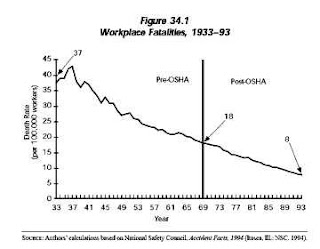 If the vertical line illustrating where OSHA was formed was not there, you would not be able to guess when it was instituted based on the graph. Workplace fatalities were already well under decline by the time safety regulations came along via OSHA. Why is this? Because one way to cut costs is to improve workplace safety, causing the supply of labor to shift to the right, and lowering the wages you have to pay. For some numbers from Bryan Caplan:
Hat Tip: Marginal Revolution, Division of Labour, and EconLog
 If the vertical line illustrating where OSHA was formed was not there, you would not be able to guess when it was instituted based on the graph. Workplace fatalities were already well under decline by the time safety regulations came along via OSHA. Why is this? Because one way to cut costs is to improve workplace safety, causing the supply of labor to shift to the right, and lowering the wages you have to pay. For some numbers from Bryan Caplan:
Annual OSHA penalties for safety violations (2002): $149,000,000
Annual Workers Compensation Premiums (2001): $26,000,000,000
Estimated Annual Wage Premiums for Risky Activities (2004 dollars): $245,000,000,000
The market punishment for riskier conditions is about nine times larger than the government regulation punishment of workers compensation and OSHA penalties. That is why we have the steadily falling time trend pictured in the graph.Hat Tip: Marginal Revolution, Division of Labour, and EconLog
Subscribe to:
Posts (Atom)